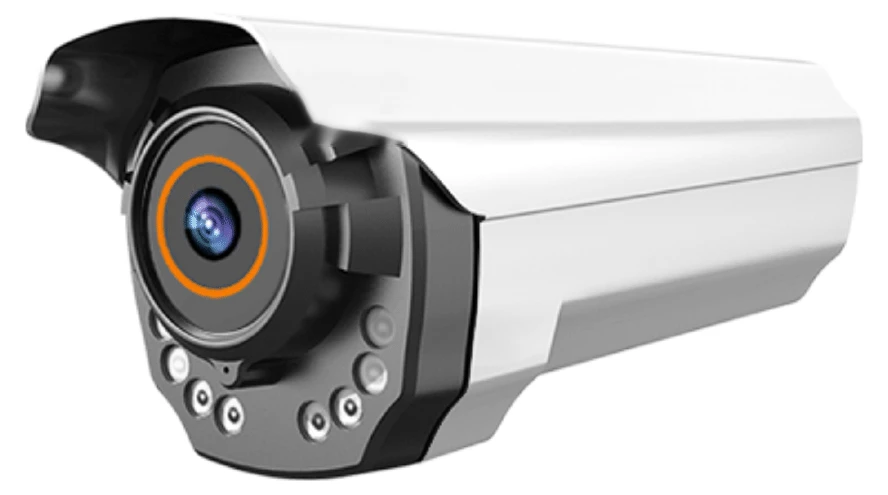
Atlas 9936 · 5MP PoE AI Bullet
The Atlas 9936 is a wired 5 MP bullet on the H4P AI platform — dual-light imaging, a 1T NPU running human and vehicle detection on the camera itself, and standard ONVIF/GB28181 access to any third-party NVR. Built for walls, poles and perimeters.
Lead time · In stock: at your forwarder’s China warehouse 3 days after payment · Not in stock: 7–15 working days · Then air 5–10 days / sea 25–45 days to your port
Terms · Sample orders welcome · Quotation / PI fixes models, prices, Incoterms (EXW or FOB, each quoted separately), lead time and T/T payment · Defective units: free spare units agreed per order (quantity depends on order size) and written into the quotation · Warranty: up to 5 years on Zhongxin Shutong industrial switches, manufacturer warranty on other brands · Full terms, warranty & RMA
Need the PDF datasheet? Get it on WhatsApp →The Atlas 9936 is a wired PoE bullet camera on the H4P mainboard — the same platform as the 9632 turret and the 9836 bullet. A 1/3″ CMOS delivers a 5 MP (2880×1620) main stream at 30 fps with dual-stream output and H.264/H.265/H.265+ encoding. Night imaging offers black-light full color, smart dual-light and IR modes, with smart light control that keeps faces from overexposing. The on-chip 1T NPU runs the AI models locally: human and vehicle detection extend into e-fence, tripwire (A→B, B→A, A↔B), absence detection and people counting with daily statistics on the OSD. Alarms can play custom-recorded or text-to-speech voice, drive an IO output such as a red-blue strobe, and link an NVR for full-screen pop-up, AI recording and push. Access is standard: ONVIF, private protocol and CGI, plus GB28181, with a built-in WEB 2.0 interface for Edge, Chrome, Safari and Firefox and EasyVMS as the PC client. Power is DC 12 V or PoE with 1236/4578 auto-sensing; the camera is rated for 0 °C to +50 °C, and the finished housing is IP67-rated for outdoor duty. For projects needing 4K detail, the 9836 can be built on the 8 MP H8P board (1/2.5″ CMOS, 3840×2160 @30 fps).
Is this the right camera for your site?
Plain-language guide — based only on what this product actually does.
- A site with no mains power and no network — the solar 4G models 9560 / 9562 are built exactly for that
- Motorized pan-tilt patrol over a large open area — pick a PTZ camera line instead
- Simple entry-level viewing with no analytics — a basic dual-light bullet costs less and does that job
Worried about the source? Order under your own company name.
Using your own freight forwarder? No problem.
Key Features
The complete series capability list.
Who uses it, where it goes and how to install it
Written for the Atlas 9936 PoE AI bullet from its own specifications: 5 MP (2880×1620) at 30 fps, dual-light night modes, 1T NPU human and vehicle detection with e-fence, tripwire and absence detection, IO output for a strobe, ONVIF and GB28181, PoE or DC 12 V, IP67.
Who it is for
- Factory and warehouse perimeters — Bullets mounted along walls and fences, with e-fence and tripwire filtered to humans and vehicles, and a red-blue strobe on the IO output to warn off an intruder before the guard arrives.
- Parking lots and truck yards — Vehicle detection separates cars and trucks from people, so after-hours rules can alarm on any person but only on vehicles crossing a set line.
- Gatehouses and guard posts — Absence detection can flag when a post is left unattended, alongside normal recording of the gate.
- Integrators on third-party NVRs and platforms — ONVIF, private protocol, CGI and GB28181 access, so a run of 9936 bullets can join an existing recorder or platform; OEM and project customization are offered.
Where and how to install
- Look along the fence, not across it — Mount each bullet inside the fence at about 2.5–3.5 m, aimed along the fence line, so a climber crosses the image clearly. Space cameras so each one also sees the base of the next pole, which covers the blind zone right under it.
- Draw zones away from moving plants — Keep the e-fence zone on the ground inside the fence, clear of hedges, flags and trees; trim vegetation along the line. Human/vehicle filtering removes most leaf and animal alarms, but a branch right in front of the lens still causes trouble at night.
- Poles: surge and earthing — On metal poles and long outdoor cable runs, fit a surge protector at the camera end and at the switch, and earth the pole. Keep the RJ45 and DC 12 V tail in a sealed junction box on the pole; the housing itself is IP67.
- Long fences: plan beyond 100 m — Copper Ethernet stops at 100 m per run. For distant fence sections, put an outdoor PoE switch in a cabinet near the cameras and link it back by fibre, or use a PoE extender; do not stretch one cable past the limit.
- Strobe wiring on the IO output — Mount the red-blue strobe where an intruder sees it but where it does not flash into the lens. The page gives no electrical rating for the IO output, so drive the strobe through a relay with its own power supply unless we confirm direct drive.
Perimeter planning table for 9936 cameras
The 9936 specifications give the lens (4 mm, 90°) but no light distance, bitrate or power draw, so this table sizes the NVR, switch and uplink for a run of cameras. It assumes 4 Mbps per camera (5 MP main stream, H.265, recorded 24 h a day) and reserves the 802.3af maximum per PoE port.
| 4 × 9936 | 8 × 9936 | 16 × 9936 | |
|---|---|---|---|
| Disk for 14 days at 4 Mbps | 2.4 TB | 4.8 TB | 9.7 TB |
| Disk for 30 days at 4 Mbps | 5.2 TB | 10.4 TB | 20.7 TB |
| NVR incoming bandwidth | 16 Mbps | 32 Mbps | 64 Mbps |
| Share of a 100 Mbps uplink | 16% | 32% | 64% |
| PoE budget reserving 15.4 W per port | 61.6 W | 123.2 W | 246.4 W |
- Up to 8 cameras fit comfortably on a 100 Mbps uplink at 4 Mbps each; for 16 cameras use a Gigabit uplink, because 64 Mbps leaves little headroom for live viewing and playback.
- A 16-camera perimeter kept for 30 days needs about 20.7 TB; if that is too much, record continuously for 14 days (about 9.7 TB) and keep AI events longer.
- The 15.4 W per port reserve is a safe planning figure, not a measured draw; ask us for the real figure before choosing a switch with a tight PoE budget.
Storage = bitrate ÷ 8 × 86400 s × days × cameras (1 TB = 1000 GB). 4 Mbps is an assumption; the page lists no bitrate. 15.4 W is the IEEE 802.3af per-port maximum at the switch; 100 m is the copper Ethernet limit per run.
Full Specifications
Series specifications — technical values in English.
Imaging & AI — H4P platform
| Housing type | Bullet |
| AI platform | H4P mainboard — 1T NPU, on-device AI models |
| Image sensor | 1/3″ CMOS |
| Lens | 4 mm · F1.4 · 90° field of view |
| Main stream | 5MP(2880×1620)@30FPS / 4MP(2560×1440) / 3MP(2304×1296) / 2MP(1920×1080) |
| Sub stream | 448P(800×448) / 360P(640×360) / CIF(352×288) |
| Compression | H.264 · H.265 · H.265+ |
| Day/Night modes | Black-light full color · Smart dual-light · IR — smart light control, faces not overexposed |
| Smart detection | Human detection · Vehicle detection |
| Smart applications | E-fence · Tripwire (A→B / B→A / A↔B) · Absence detection · People counting (daily stats, OSD overlay) |
| Alarm | Voice broadcast (custom recording) · IO output with red-blue light linkage · NVR linkage: full screen, local voice, AI recording, push |
| Image adjustment | Auto white balance · DWDR · BLC · brightness/contrast/hue adjustable |
| Privacy & OSD | Privacy mask · Mirror · OSD setting with drag positioning |
Network
| Ethernet | RJ-45 10M/100M adaptive |
| Protocols | ONVIF, P2P, CGI, HTTP, TCP/IP, IPv4, RTSP, UDP, NTP, DHCP, DNS, GB28181 |
| Access protocols | ONVIF / private protocol / CGI |
| Client | NVR central management · EasyVMS PC client |
| Web interface | Built-in WEB 2.0 — Edge, Chrome, Safari, Firefox (non-IE) |
Audio
| Audio codec | G.711U · G.711A |
| Audio input | Supported (−36 dB MIC recommended) |
| Audio output | Supported, built-in amplifier (8 Ω 2 W recommended) |
| Two-way talk | Supported — audio and video in sync |
General
| Board size | 38×53 mm, 38×38 mm hole pitch |
| Housing size / weight | 98×98×202 mm · approx. 376 g · white |
| Operating environment | 0 °C to +50 °C · IP67 housing |
| Power | DC 12 V / PoE — 1236/4578 auto-sensing |
| Packing | In the box: camera, certificate of conformity · color box 230×130×120 mm, 0.478 kg gross · carton: 40 pcs, 540×475×625 mm, 20.5 kg gross |
PoE AI Camera FAQ — Atlas 9936
How does the 9936 differ from the 9632 and 9836?
Do they work with third-party NVRs — ONVIF, GB28181?
How are they powered — PoE or 12 V?
What AI runs on the camera itself?
Can they show color at night without blinding people?
How do I set up the Atlas 9936 e-fence on a perimeter without constant false alarms?
My fence runs more than 100 m from the switch — how do I connect the far Atlas 9936 cameras?
What can I connect to the IO output of the Atlas 9936 — a strobe, a siren?
What does absence detection on the Atlas 9936 do, and where is it useful?
How much NVR storage do I need for a perimeter of Atlas 9936 cameras?
Ordering questions — samples, shipping, payment, lead time and genuine stock — are answered once on our FAQ page.
Related Products


Request a quote for this product
An engineer replies within 24 hours on working days with model check, price and lead time. No obligation, no newsletters.
Product: Atlas 9936 · 5MP PoE AI Bullet
For a fast, exact quote tell us: model or requirement · quantity · destination country / port · EXW or FOB · deadline.