

ZTE Wantong S2150-S · FE Access
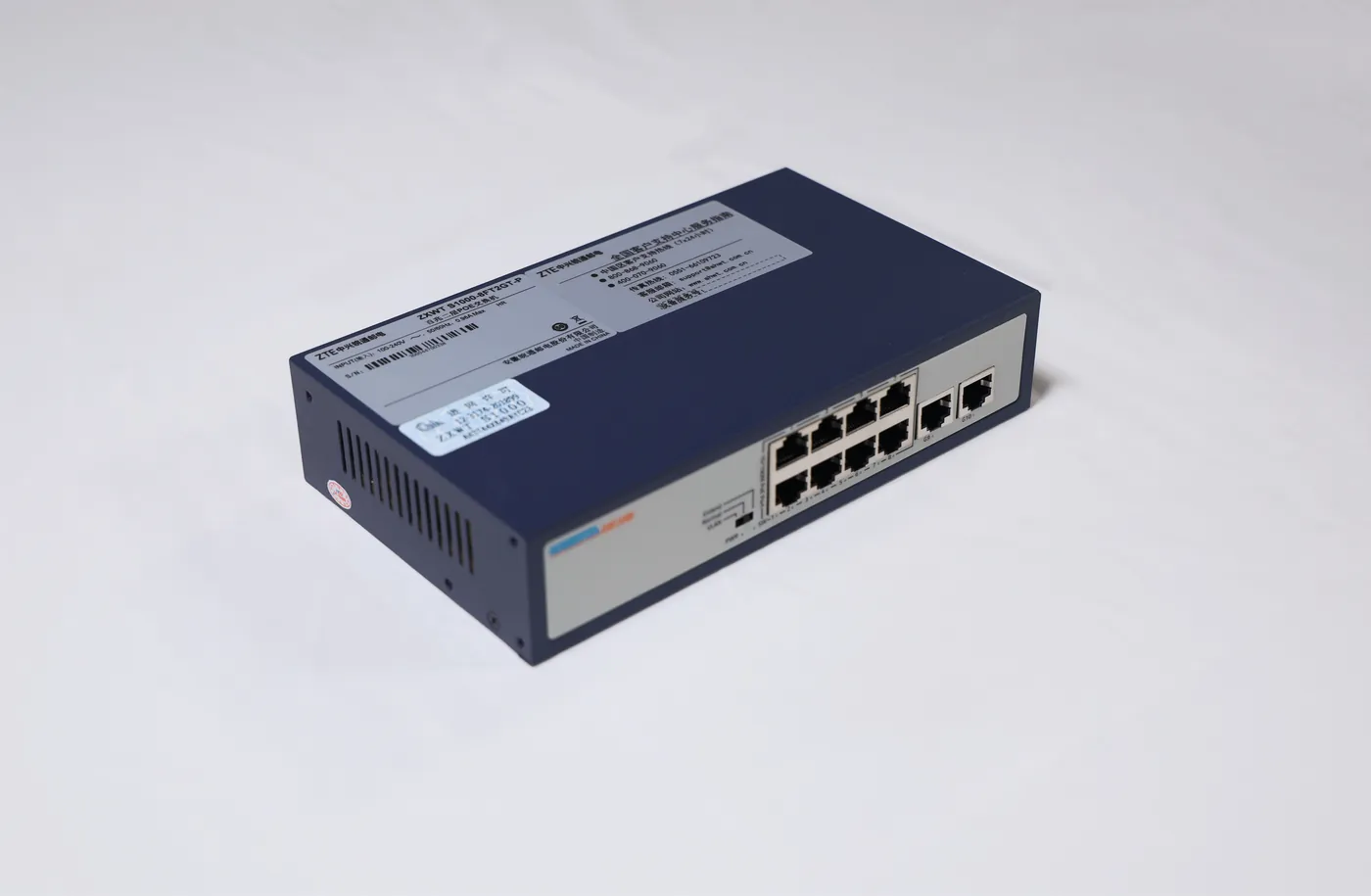
Managed fast-ethernet access switches for campus edges, building broadband and camera or desk access — 8 or 24 FE RJ45 ports with gigabit fiber/copper uplinks, fanless and silent, with ZESR ring protection and zero-touch deployment. We deliver them configured as part of the network solutions we build.
Lead time · In stock: at your forwarder’s China warehouse 3 days after payment · Not in stock: 7–15 working days · Then air 5–10 days / sea 25–45 days to your port
Terms · Sample orders welcome · Quotation / PI fixes models, prices, Incoterms (EXW or FOB, each quoted separately), lead time and T/T payment · Defective units: free spare units agreed per order (quantity depends on order size) and written into the quotation · Warranty: up to 5 years on Zhongxin Shutong industrial switches, manufacturer warranty on other brands · Full terms, warranty & RMA
Need the PDF datasheet? Get it on WhatsApp →The ZTE Wantong S2150-S series is the fast-ethernet access line of the ZTE Wantong campus switching family, built for the edge of the network where 100 Mbps per port is enough: IP cameras, desk PCs, IP phones, access control panels and building broadband subscribers. The S2150-10C-S has 8 FE RJ45 ports and 2 GE Combo uplinks; the S2150-28C-S has 24 FE RJ45 ports, 2 GE SFP and 2 GE Combo uplinks. Both are fanless, draw 11 W and 17.1 W at most, and share one software set: 4K VLANs with QinQ and VLAN translation, ZESR/ZESR+ ring protection, IGMP snooping and controllable multicast, dual-direction ACLs, DAI and IP Source Guard, plus zero-touch deployment and M-Button for fast roll-out. The series has no PoE. All specifications are quoted from the manufacturer's datasheet.
Two sizes, one software set
Both models run the same features — the choice comes down to port count, uplinks and mounting.
Is this the right access series for you?
Plain-language guide — based only on what these switches actually do.
- Gigabit desk ports or PoE+ for cameras and APs — see the ZTE Wantong S5150 gigabit access series, or the S1000 SMB series for simple PoE
- 10G uplinks — the ZTE Wantong S5160-HE series adds 10G uplinks on gigabit access, and the S5860-E series handles 10G aggregation
- A routing gateway with dynamic routing between VLANs — the ZTE Wantong S5860-S smart L3 routing switches cover that
Worried about the source? Order under your own company name.
Using your own freight forwarder? No problem.
Key Features
The series capability list — from the manufacturer's datasheet.
Who uses it, where it goes and how to plan FE access
Written for the ZTE Wantong S2150-S access series from its own specifications: 2 fanless models with 8 or 24 FE RJ45 ports, 2 or 4 GE uplinks, 64 Gbps switching capacity, 11–17.1 W maximum power, no PoE.
Who it is for
- ISPs and building-broadband operators — One FE port per subscriber, with QinQ, 1:1 and 1:N VLAN translation, MFF, port isolation and DHCP Option 82 keeping customers apart, and SNMP v1/v2/v3, RADIUS/TACACS+ and NetNumen U31 for the operator's NMS.
- CCTV and access-control installers — Managed edge switch for cameras, door controllers and alarm panels that already have their own power: VLANs separate the camera network, IGMP snooping keeps multicast video off other ports, and GE fiber uplinks reach the NVR room.
- Schools, hotels and SME offices — Silent fanless access for classrooms, guest rooms and office desks where 100 Mbps per user is enough; Voice VLAN for IP phones and 802.1x/RADIUS so only approved devices get on the network.
- Integrators rolling out many small sites — Branches, shops or substations with identical switches: zero-touch deployment and the Easy Manager batch tool push software and configuration in one go, and ZGMP cluster management handles many units from one point.
Where and how to install
- Rack, wall box or desk — Both models are 43.6 mm (1U) high and 220 mm deep, so they fit a shallow wall cabinet. The S2150-28C-S is 442 mm wide for a 19-inch rack; the S2150-10C-S is 340 mm wide, narrower than 19 inches, so use a shelf, a wall box or a desktop position.
- Power — Single AC input, 100–240 V, 50–60 Hz, with a maximum draw of 11 W (10C-S) or 17.1 W (28C-S), so a small UPS keeps them running for a long time. There is no redundant power input, so the UPS is the redundancy; the power-loss alarm reports outages to the NMS.
- Cooling and temperature — Fanless natural cooling, rated -5°C to +50°C at 10%–90% humidity and below 3000 m altitude, with 33 or 55 BTU/h heat output. With no fan, nothing pulls air through the case, so leave space around the vents and keep the switch away from hot devices in a closed box.
- Fiber or copper uplinks — The 10C-S has 2 GE Combo uplinks (each one either RJ45 or SFP); the 28C-S adds 2 dedicated GE SFP ports. Use fiber for any run over 100 m or between buildings, and fit the same module type and wavelength at both ends; the Combo ports also accept FE optical modules for older fiber links.
- Management network — Put each switch's management IP in a dedicated management VLAN reachable only from the NOC, and use SSH and SNMP v3 rather than Telnet. Both models have an out-of-band management port and an RJ45 console port; label them and keep a console cable in the cabinet for first setup and recovery.
S2150-S series planning: which of the 2 models
Both are fanless FE access switches with GE uplinks and the same software; they differ in port count, number of uplinks and width. Neither has PoE. Uplink bandwidth is the sum of the GE uplinks; for camera sites, add up your streams (for example about 8 Mbps per camera) and keep the total well under the uplink you actually use.
| 10C-S | 28C-S | |
|---|---|---|
| Access ports | 8×FE RJ45 | 24×FE RJ45 |
| Uplinks | 2×GE Combo | 2×GE SFP + 2×GE Combo |
| Total GE uplink bandwidth | 2 Gbps | 4 Gbps |
| 10G / 25G / 40G / 100G uplink | — | — |
| Switching capacity | 64 Gbps | 64 Gbps |
| Packet forwarding rate | 4.2 Mpps | 15.6 Mpps |
| Max power consumption | 11 W | 17.1 W |
| Width / mounting | 340 mm / shelf or desktop | 442 mm / 19-inch 1U |
| L3 routing | static IPv4 / IPv6 | static IPv4 / IPv6 |
| Power redundancy / cooling | single AC / fanless | single AC / fanless |
| Typical position | FE desk / camera access, small office | FE floor access, building broadband |
- Pick the S2150-10C-S for a small office, shop or guard post with up to 8 devices: one Combo port uplinks over fiber or copper and the other stays free for a second path.
- Pick the S2150-28C-S for a building floor or a ring: two SFP ports can close a ZESR ring while the two Combo ports stay available for local uplinks or expansion.
- If the devices need PoE or gigabit ports, this is the wrong series: look at the S5150 gigabit access series or the S1000 SMB PoE switches instead.
— = not listed on the page / not applicable. Values are from the page's specification tables; total uplink bandwidth is arithmetic (number of GE uplinks × 1 Gbps). The manufacturer lists no PoE for this series.
Full Specifications — Model by Model
Series specifications with one column per model — technical values in English. The highlighted column follows your model selection above.
S2150-S Series — Hardware & Environment (2 models)
| Item | 10C-S | 28C-S |
|---|---|---|
| Fixed ports | 8×FE RJ45 + 2×GE Combo | 24×FE RJ45 + 2×GE SFP + 2×GE Combo |
| Switching capacity | 64 Gbps | |
| Packet forwarding rate | 4.2 Mpps | 15.6 Mpps |
| Console | 1×console port (RS232, RJ45) | |
| Management port | Out-of-band management Ethernet port | |
| Dimensions (H×W×D) | 43.6×340×220 mm | 43.6×442×220 mm |
| Max weight | 2.8 kg | 3 kg |
| AC power | 100–240 V, 50–60 Hz, single power supply | |
| Max power consumption | 11 W | 17.1 W |
| Cooling | Fanless, natural cooling | |
| Max heat dissipation | 33 BTU/h | 55 BTU/h |
| Operating environment | -5°C to +50°C, humidity 10%–90% | |
| Operating altitude | < 3000 m | |
| MTBF / MTTR | > 100,000 hours / < 30 minutes | |
S2150-S Series — Software Features (both models)
| Item | 10C-S | 28C-S |
|---|---|---|
| MAC | IEEE 802.1d automatic MAC address learning / MAC address aging / port-MAC binding / per-port MAC learning limit | |
| Port features | Jumbo frames up to 10K bytes / speed and duplex auto-negotiation / MDI/MDIX auto-crossover / Virtual Cable Test / port loopback test / broadcast, multicast and unknown-unicast suppression | |
| Link aggregation | IEEE 802.3ad LACP / static trunk / max 15 groups, max 8 ports per group | |
| Mirroring | Port mirroring of ingress, egress or both directions / one-to-one, many-to-one, many-to-many / flow-based mirroring / RSPAN remote mirroring | |
| VLAN | 4K VLANs / port-, protocol-, IP-subnet- and MAC-based VLAN / Voice VLAN / VLAN translation (1:1, 1:N) / PVLAN / QinQ and flexible QinQ / GVRP | |
| Ring & link protection | STP / RSTP / MSTP / ZESR / ZESR+ ring protection (50 ms class) / ZESS (ZTE Ethernet Smart Switch) link protection | |
| DHCP | DHCP Snooping / DHCP Relay / DHCP Option 82 | |
| IP routing | IPv4 static routing / IPv6 static routing | |
| IPv6 | IPv6 Ping, IPv6 Telnet / ND (Neighbor Discovery) / MLD Snooping / DHCPv6 Snooping / IPv6 ACL | |
| Multicast | IGMP v1/v2/v3 / IGMP snooping, filtering, proxy and fast leave / controllable multicast, CAC channel access control / MVR multicast VLAN registration / user multicast access control and access logging | |
| ACL | MAC- and IP-based standard ACL / L2, extended (5-tuple), hybrid, user-defined and VLAN ACLs / time-based ACLs / ACLs in both ingress and egress directions | |
| QoS | Port- and flow-based bandwidth management / 8 hardware queues per port / 802.1p and IP DSCP marking, remarking and mapping / SP, WRR, SP+WRR scheduling / tail-drop congestion avoidance | |
| Security | Hierarchical user management and password protection / CPU anti-attack and CPU overload protection / broadcast-multicast-unknown-unicast suppression / port isolation / Dynamic ARP Inspection / 802.1x with RADIUS authentication / STP Root Guard and BPDU attack protection / IP Source Guard / MFF | |
| Ease of maintenance | M-Button / zero-touch deployment / dual backup of software image | |
| Device management | RS232 console (RJ45) / out-of-band management port / CLI, Telnet, SSH / Web / FTP, TFTP / local and remote (RADIUS/TACACS+) login authentication and authorization / SNMP v1/v2/v3 / DHCP client / NetNumen U31 NMS / Easy Manager zero-touch and batch inspection tool / cluster management (ZGMP) / NTP, Syslog, RMON / sFlow / power-loss alarm | |
Fast Ethernet Access Switch FAQ — S2150-S Series
What is the difference between the S2150-10C-S and the S2150-28C-S?
Are 100 Mbps access ports enough for IP cameras?
Can the S2150-S power cameras or access points over PoE?
How fast does the ring recover if a fiber link is cut?
Can the S2150-S act as the gateway and route between VLANs?
Can I order under my own company name and use my own forwarder?
Which SFP modules can I use in the S2150-S uplink ports?
Can the S2150-S work in a network built on Huawei, H3C or Cisco switches?
How do I keep apartments or hotel rooms isolated from each other on one S2150-S?
What do zero-touch deployment and M-Button change for a large roll-out?
Can the S2150-S carry IPTV or multicast video without flooding every port?
Ordering questions — samples, shipping, payment, lead time and genuine stock — are answered once on our FAQ page.
Related Products


Request a quote for this product
An engineer replies within 24 hours on working days with model check, price and lead time. No obligation, no newsletters.
Product: ZTE Wantong S2150-S · FE Access
For a fast, exact quote tell us: model or requirement · quantity · destination country / port · EXW or FOB · deadline.