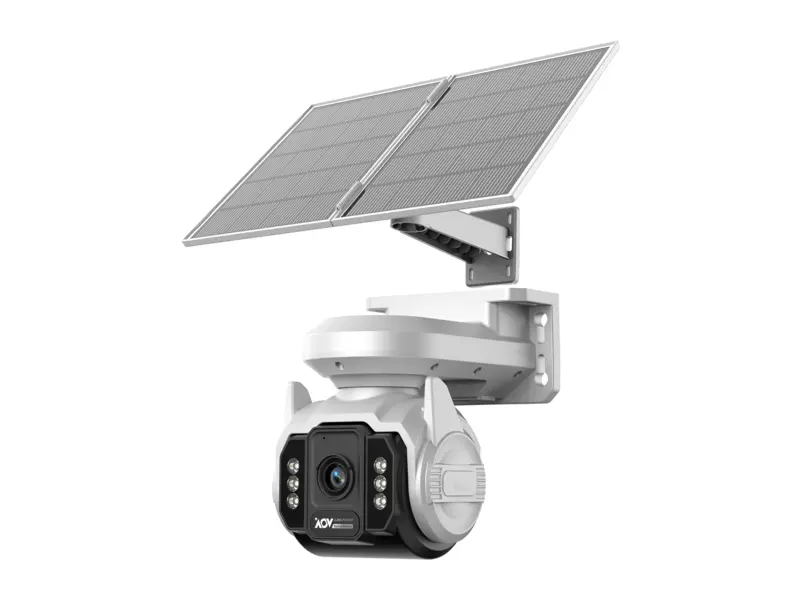
Atlas 6601 · AOV Solar 4G PTZ
An auto-guarding PTZ ball for points with no power and no network: solar battery, 4G link and human tracking. It watches on its own, and when it detects a person it turns to follow, records at full frame rate and sounds a light-and-siren warning.
Lead time · In stock: at your forwarder’s China warehouse 3 days after payment · Not in stock: 7–15 working days · Then air 5–10 days / sea 25–45 days to your port
Terms · Sample orders welcome · Quotation / PI fixes models, prices, Incoterms (EXW or FOB, each quoted separately), lead time and T/T payment · Defective units: free spare units agreed per order (quantity depends on order size) and written into the quotation · Warranty: up to 5 years on Zhongxin Shutong industrial switches, manufacturer warranty on other brands · Full terms, warranty & RMA
Need the PDF datasheet? Get it on WhatsApp →The Atlas 6601 is a single-lens solar PTZ ball built on a 4G low-power AOV module with a 0.5T-compute dual-core AI controller running embedded Linux. The pan-tilt head covers a point of interest with 6 presets, a guard position, position calibration and human tracking, so one camera can watch a gate, yard or perimeter on its own. The 1/3.2″ sensor encodes 1920×1080 (2 MP) at H.265+ and 15 fps, keeping both TF-card storage and 4G data low. Human detection reaches 40 m at a stated 99.88% accuracy; the camera records in low-power AOV mode and switches to full-frame recording within 50 ms of a detection, with a sound-and-light alarm through the dual-light board and four night modes (B/W, full-color, smart, starlight) plus ICR day/night switching. Power is a 3.7 V lithium battery charged by a solar panel at about 320 mA working current; recordings go to a TF card up to 256 GB (FAT32), with cloud storage available as a paid option. All-network 4G (LTE-FDD and LTE-TDD) auto-connects to the server on power-up with QR-code device adding, and triple drop-line protection with fault self-diagnosis keeps the link up and helps installers locate problems. The HiEasy app offers 17 interface languages.
Is this the right camera for your site?
Plain-language guide — based only on what this product actually does.
- Continuous full-frame 24/7 recording at high frame rate — a mains-powered PoE camera (see the Atlas H series) is the right tool
- A site that already has stable mains and Ethernet — wired PoE costs less and never depends on sunshine
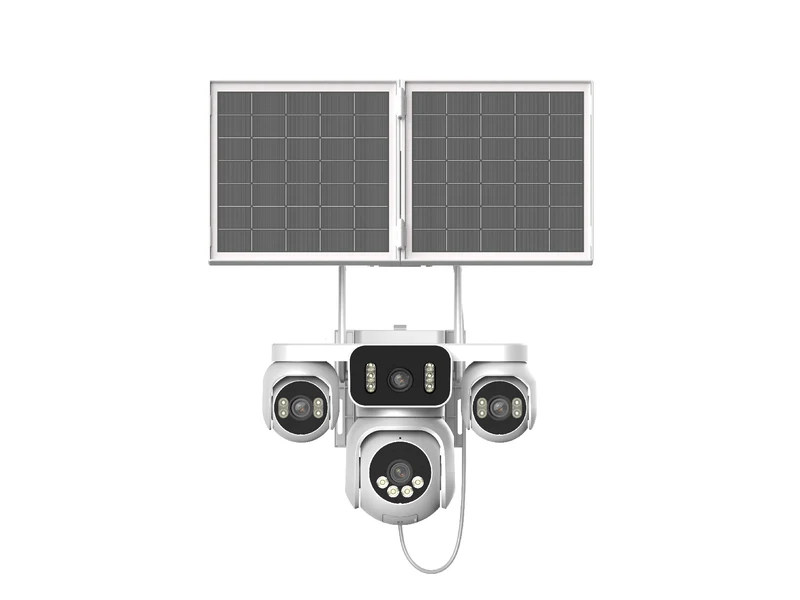
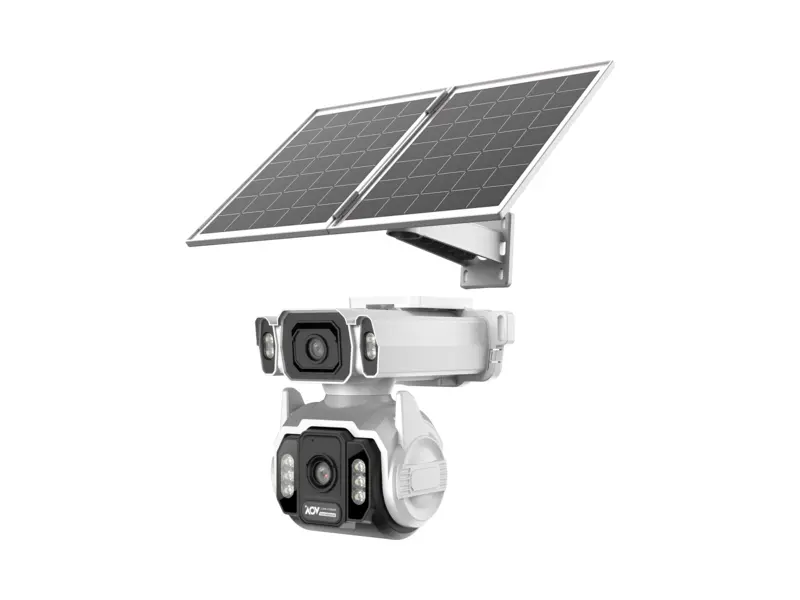
- Wide multi-lens coverage of a whole yard from one head — the Atlas 9560 quad-lens or 9562 dual-lens solar cameras cover more angles
Worried about the source? Order under your own company name.
Using your own freight forwarder? No problem.
Key Features
The complete series capability list.
Who uses it, where it goes and how to install it
Written for the Atlas 6601 solar 4G PTZ from its own specifications: 1080P single-lens pan-tilt ball, 40 m human detection and tracking, AOV recording with 50 ms switch to full frame, 3.7 V battery + solar panel, 4G LTE.
Who it is for
- Farms, ranches and plantations — A gate, pump or feed store far from any power line: the battery and panel replace mains, 4G replaces the internet line, and the pan-tilt head with 6 presets watches several spots from one pole.
- Construction sites and remote assets — Machinery yards, cable stock, towers and pump stations where cabling is temporary or impossible; on a human detection it turns to follow the person and fires the sound-and-light warning.
- Installers covering off-grid perimeters — One unit per stretch of fence or boundary post, no trenching: 4G auto-connects on power-up and the device is added by QR code, so commissioning on site is quick; triple drop-line protection and fault self-diagnosis help with remote support later.
Where and how to install
- Sun first, then the view — Choose a pole or wall where the solar panel gets direct sun from mid-morning to mid-afternoon with no shade from trees, roofs or the pole itself. The camera can face any direction; the panel must face the equator (south in the northern hemisphere, north in the southern) and stay clean.
- Height and detection range — Mount at about 3–4 m: high enough to be out of reach, low enough that a person at the 40 m detection limit is still a clear target. Set the guard position on the main approach so the ball returns there after tracking.
- 4G signal at the exact pole — Test the signal with a phone on the same carrier at the mounting height, not at the site office. Bands supported: LTE-FDD B1/B3/B5/B8 and LTE-TDD B34/B38/B39/B40/B41 (Asia version; EU and US versions with other bands are available). If you are unsure which bands your site uses, ask for our free remote band check before ordering.
- Keep the alarm zone clean — Every human detection wakes full-frame recording, tracking and the siren, which costs battery and 4G data. Do not aim the guard position at a public road or footpath; point it at your own gate, yard or fence line.
- Climate limits and the TF card — The stated operating range is −20 °C to 55 °C; on very hot sites keep the body out of a sun trap such as a metal wall. Fit a TF card of up to 256 GB formatted FAT32 before closing the unit, so it records locally from the first day.
Power, data and storage: planning figures
The page does not publish a lens focal length or view angle for the 6601, so this table works with what it does publish. Recording stays on the TF card, so 4G data is used mainly when you watch live or play back remotely. Battery capacity and panel size are not stated; the power rows only show what the stated working current means.
| 6601 · solar 4G PTZ | |
|---|---|
| Video | 1920×1080 (2 MP) · H.265+ · 15 fps |
| Human detection / switch to full frame | 40 m · 50 ms |
| Power at stated working current | ≈ 1.2 W (3.7 V × 320 mA) |
| Upper bound per 24 h if it drew working current all day | ≈ 28.4 Wh (≈ 7.7 Ah at 3.7 V) |
| Battery capacity and panel size | not stated — confirmed per order |
| 4G data per hour of live view | ≈ 61 MB (135 kbps) – ≈ 0.92 GB (2048 kbps) |
| 256 GB TF card, continuous recording | ≈ 11.6 days at 2048 kbps · ≈ 175 days at 135 kbps |
| LTE bands | Asia: FDD B1/B3/B5/B8 · TDD B34/B38/B39/B40/B41; EU: FDD B1/B3/B5/B7/B8/B20/B28; US: FDD B2/B4/B5/B7/B12/B13/B66/B41(38) |
| Operating temperature | −20 °C to 55 °C |
- Pick the 6601 solar when the point has neither power nor internet and one tracking head is enough; it follows a person up to 40 m.
- Need several fixed angles of one yard at the same time? Look at the Atlas 9560 quad-lens or 9562 dual-lens solar cameras instead.
- If mains power and Ethernet already reach the point, a wired PoE camera costs less and does not depend on sunshine.
Calculated from the page: power = 3.7 V × 320 mA; data = bitrate × time (1 GB = 1000 MB); card days = 256 GB ÷ (bitrate ÷ 8 × 86400 s). Real AOV draw and bitrate are usually below these limits, so treat them as worst-case planning values.
Full Specifications
Series specifications — technical values in English.
System
| Model | 6601 — AOV single-lens solar 4G PTZ camera |
| Module | X25H (4G low-power AOV module) |
| Main processor | High-performance dual-core, 0.5T AI compute |
| Operating system | Embedded Linux |
Video
| Image sensor | 1/3.2″ CMOS |
| Video compression | H.265+ |
| System format | PAL 50 Hz / NTSC 60 Hz |
| Effective resolution | 1920×1080 (2 MP) |
| Frame rate | 15 fps |
| Video bitrate | 135–2048 kbps |
| Min. illumination | Day mode 1 Lux · Night mode 0.01 Lux |
| Day/Night | ICR auto switch |
| Night modes | B/W · Full-color · Smart · Starlight |
| Snapshot | Supported |
4G Network
| Network mode | All-network 4G |
| Asia / China version (standard) | LTE-FDD B1 / B3 / B5 / B8 · LTE-TDD B34 / B38 / B39 / B40 / B41 |
| EU version | LTE-FDD B1 / B3 / B5 / B7 / B8 / B20 / B28 |
| US version | LTE-FDD B2 / B4 / B5 / B7 / B12 / B13 / B66 / B41(38) |
| Latin America / Japan / Korea | Dedicated module versions, band list confirmed per order |
| Server connection | Auto-connect on power-up · QR-code device adding |
| Data top-up & query | Supported |
Audio
| Audio codec | G.711U |
| Audio input | External MIC, −42 dB |
| Audio output | External 8 Ω / MAX 2 W speaker |
| Voice call | Full-duplex two-way talk (echo cancellation) |
Recording & Alarm
| Recording modes | AOV recording · Human-triggered full-frame recording |
| Recording storage | TF card · cloud storage (paid option) |
| TF card capacity | Up to 256 GB (FAT32) |
| AI detection | Human detection to 40 m, 99.88% accuracy |
| Detection response | 50 ms switch to full-frame recording |
| Sound-light alarm | Supported (dual-light board) on human detection |
| Reliability | Triple drop-line protection · fault self-diagnosis |
PTZ & App
| Presets | 6 positions |
| Guard position | Supported |
| Position calibration | Supported |
| Tracking | Human tracking |
| Mobile app | HiEasy — 17 interface languages |
Power & Physical
| Power supply | 3.7 V lithium battery · solar panel charging |
| Working current | 320 mA ±10 mA |
| Operating environment | −20 °C to 55 °C |
| Mainboard size | 59.5 × 38.4 mm |
| Sensor board | 38 × 38 mm |
| Power board | 53 × 10.5 mm |
| ICR / lens hole pitch | 20 mm |
Solar 4G PTZ Camera FAQ — Atlas 6601
Does the Atlas 6601 need a SIM card, and which 4G bands does it support?
Can it work on a site with no mains power and no internet line?
How far can it detect people at night, and what night modes does it have?
Will the battery hold up through cloudy days on solar charging?
Does it support PTZ tracking, presets and two-way talk?
Which way should the solar panel of the Atlas 6601 face, and at what tilt?
Can you check which 4G bands are used at my remote site before I order the Atlas 6601?
How much mobile data will the Atlas 6601 use per month?
How long does a 256 GB card last in the Atlas 6601, and why does it say FAT32?
Will animals, trees or passing cars set off false alarms on the Atlas 6601?
What happens if the Atlas 6601 battery runs flat after a long bad-weather spell?
Which 4G version of the Atlas 6601 should I order for my country?
Will it work with my local 4G carrier?
Ordering questions — samples, shipping, payment, lead time and genuine stock — are answered once on our FAQ page.
Related Products


Request a quote for this product
An engineer replies within 24 hours on working days with model check, price and lead time. No obligation, no newsletters.
Product: Atlas 6601 · AOV Solar 4G PTZ
For a fast, exact quote tell us: model or requirement · quantity · destination country / port · EXW or FOB · deadline.